

Originally published as part of my participation in the 2025 Clean Energy Leadership Institute (CELI) Fellowship on CELI’s Medium page on December 14, 2025.
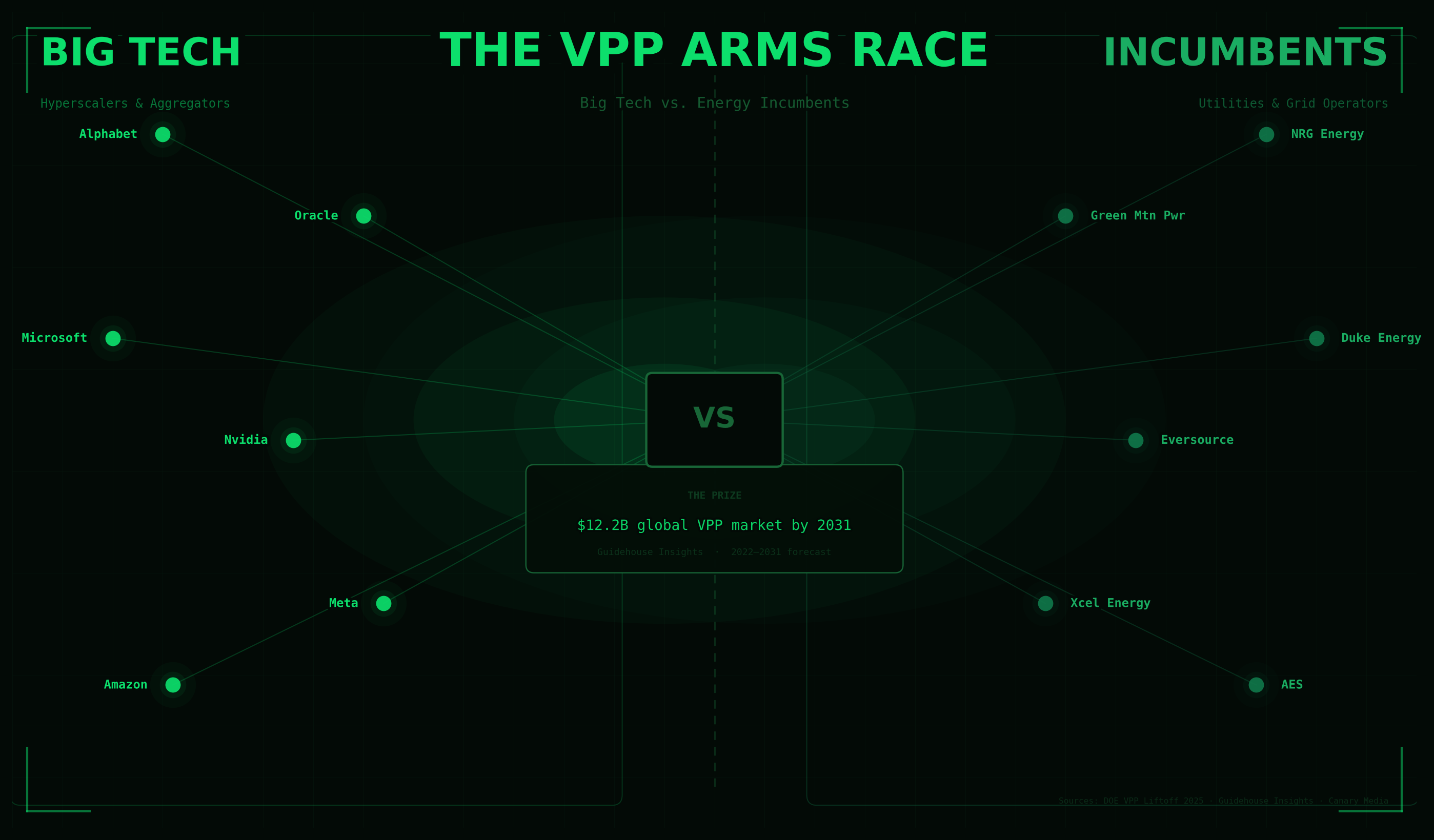
Big Tech is moving from large power customer to grid shaper, and flexible energy through virtual power plants (VPPs) are the battleground. If utilities and traditional VPP aggregators don’t modernize how they recruit, measure, and pay for distributed flexibility, customers will pick tech-driven options; and market power over demand-side resources will shift with them.
The stakes are immediate: data-center load is exploding, interconnection queues are clogged, and the fastest scalable capacity is on the customer side of the meter.
Why this is a race
The numbers are changing fast. Wood Mackenzie reports a 33% jump in VPP deployments year-over-year, with North America’s VPP capacity reaching ~37.5 Gigawatts in 2025 and a surge of new off-takers tied to data center demand. Yet capacity growth is lagging deployments, a sign that market rules and utility enrollment caps, not technology nor consumer demand, are the binding constraints.
Translation: demand for flexible capacity is real, however, program design and accreditation for these flexible resources need to catch up.
At the same time, the U.S. Department of Energy says scaling VPPs to 80–160 GW by 2030 could cover 10–20% of peak load and save ~$10 billion annually, a scale only achievable if customer enrollment and measurement become as seamless as any consumer app. That is Big Tech’s home turf.
Big Tech’s opening moves
Meta just created a power-marketing arm, Atem Energy, and filed at FERC to sell energy, capacity and ancillary services in wholesale markets, directly aligning its data-center growth with energy market participation. It is a clear signal: hyperscalers won’t wait passively for capacity. They will procure, build, and even sell it.
Google has already helped assemble residential flexibility at scale. In 2024, Google’s Nest Renew combined with OhmConnect to form Renew Home, which claims several gigawatts of controllable load today and a goal of 50 GW by 2030.
Amazon brings distribution more than programs, with hundreds of millions of Alexa-enabled devices and the Sidewalk low-bandwidth network that connects sensors and appliances outside Wi-Fi’s range. Pair that extensive plumbing with simple “Energy Savings Incentives” enrollment for the Amazon Smart Thermostat and you have a ready on ramp to mass market demand response, even if Amazon isn’t the aggregator of record.
Seen together, these moves don’t yet make Big Tech the winner in VPP operations. They make Big Tech a powerful distribution layer that VPPs ride on: instant customer reach to massive existing audiences, simple UX, and the cloud and AI tooling to forecast and dispatch capacity at scale.
Data centers change the stakes
The grid crunch is not abstract. New AI-based facilities are multi-hundred-megawatt to gigawatt-scale, with timelines measured in quarters, not decades. Rocky Mountain Institute’s (RMI) latest brief argues that “many traditional solutions now face high costs and supply chain constraints, finding new ways to quickly, cost-effectively upgrade the electricity system will be essential to power the next stage of American economic growth.” Rapid data center expansion heralds that next stage of economic growth and VPPs are the fastest, cheapest way to enable this step into the future. RMI outlines contract models in which large loads sponsor VPP capacity to earn faster interconnections. That’s a blueprint for hyperscalers to finance CELI's Medium pagelocal flexibility and for utilities to safely count it toward capacity needs.
Emerging offers make this concrete. Voltus’s “bring-your-own capacity” model lets a data-center developer fund a VPP in the surrounding community and deliver those megawatts directly to the utility’s capacity stack, an out-of-market structure aimed to meet the needs of hyperscalers between now and 2030.
WattCarbon’s “Repowering California” proposal would issue certificates for verified, utility-accredited savings from distributed energy resources that data centers can use to demonstrate local headroom when negotiating interconnections. Different mechanics, same idea: pay to stand up flexibility where you need it, now.
What Utilities can do now
Treat VPPs as capacity, not pilots. Publish locational capacity needs and standardize accreditation so third parties (including hyperscalers) can fund VPP Megawatts that “count” toward interconnection needs and resource adequacy. Instead of continuing to proceed in the small capped megawatts world of the past.
Adopt “sponsor-a-VPP” tariffs. Create optional riders that let large loads finance VPPs and recover costs while protecting other customers, mirroring how power purchase agreements operate today.
Open up data access…securely Implement Green Button Connect–style sharing to accelerate enrollment and measurement & verification, while maintaining distribution-system safeguards. (RMI)
Be an aggregator-of-aggregators. Procure capacity from multiple VPP providers (and, where it pencils, from hyperscaler-sponsored programs) to diversify portfolios and lower procurement cost and risk.
What Big Tech must prove
Big Tech’s platform edge won’t matter unless it delivers additional, reliable, and verifiable capacity at the specific nodes where utilities need it:
Additionality: They can’t just rebadge legacy thermostat demand response capacity. They must finance resources that provide multi-hour, seasonal headroom, not only emergency curtailments.
Reliability: Offer telemetry and performance guarantees familiar to system planners; align dispatchability with local constraints, not just wholesale price spikes. RMI’s models aim squarely at this bar.
Speed with governance: Coordinate with incumbent planners so distribution protection, outage response, and customer bill impacts aren’t afterthoughts.
The control point that decides the winner
This race won’t be decided by who owns the most thermostats or batteries; it will be decided by who owns the enrollment, data, and workflows that turn devices into accredited capacity where and when it’s needed down to a hyper local level. Today, the consumer funnel and UX favor Big Tech. The authority to make those megawatts “real” still sits with utilities, aggregators, and market operators.
If utilities lean in, publishing needs, standardizing accreditation, providing data access, and buying capacity from VPPs, the result is faster interconnections for data centers, lower system costs, and better monthly utility bills for residential customers. If they don’t, Big Tech and its partners will keep inventing workarounds and, piece by piece, redefine who controls the future of the grid. The race is on, the smart money will fund flexibility and insists it counts.